Thursday, October 18
EXAM #2 PART 1
The Columbian Exchange transformed the world in a more radical (extreme) way than any other development in world history. One significant effect of this process (A series of actions) was the establishment of the Triangle Trade. While many factors were a part of the Triangle Trade, the rapid growth in both supply and demand for new commodities was the largest motivating element. This time period may be best associated (Related to) with economic developments, but it is impossible to analyze (to look at) this period without considering the intense social impact that the Triangle Trade had on those involved. In truth, a full understanding can only be gained by appreciating (Increase in value) how economic and social factors (something that effects something) impact each other in history.

Wednesday, October 3
project #1

Few people realize that Brazil was actually the largest participant in the slave trade. Forty percent of all slaves that survived the Atlantic crossing were sent to Brazil. While only 4 % were sent to the U.S. At one time half of the population of Brazil were slaves. Brazil was the last country to get rid of slavery. Escaped slaves found safety in dense jungles or remote mountain regions. where they set up settlements under different names such as quilombo or 'palenque. which is a small fort like village where the slaves good live there lives and be free. Today Brazil has the largest population of African-Americans outside of the United States. The population in which at least 60 percent is of African descent. Statistics on the number of slaves imported into Brazil range from 1025 million
Thursday, September 27
EXAM #1
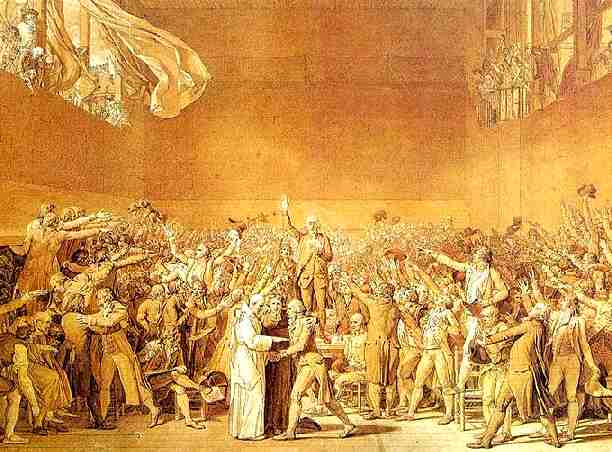 this picture shows a group of people reaching to shake each others hand. this picture describes the french rev because it shows fertility.
 this picture shows a group of woman in an army? the group of woman is being lead by a man. this describes the revolution because is shows equality.
 This picture shows the destruction of the Bastille. The destruction of the Bastille meant the people would not have to live in fear any more of being put in the prison like structure. this discribes the french rev. because it shows liberty.
Tuesday, September 25

Bastille fortress and state prison in Paris, located, until its demolition (started in 1789), near the site of the present Place de la Bastille. It was begun c.1369 by Hugh Aubriot, provost of the merchants [mayor] of Paris under King Charles V. Arbitrary and secret imprisonment by lettre de cachet gave rise to stories of horror, but actually the Bastille was generally used for persons of influence, and its regime for most political prisoners was mild. As a symbol of absolutism the Bastille was hated. It had strategic importance, for its guns commanded one of the gates of Paris. On July 14, 1789, a Parisian crowd stormed the Bastille in the hope of capturing ammunition. The governor was killed; the seven inmates, none of them political prisoners, were freed. The storming of the Bastille marks the beginning of the French Revolution, and July 14—Bastille Day—became the national holiday of republican France.
WEB SITE: http://www.infoplease.com/ce6/history/A0806447.html
 Danton, Georges Jacques 1759–94, French statesman, one of the leading figures of the French Revolution. A Parisian lawyer, he became a leader of the Cordeliers early in the Revolution and gained popular favor through his powerful oratory. A member of the Commune of Paris, he helped set the stage for the Aug., 1792, attack on the Tuileries and the overthrow of the monarchy. In the new republic, he became minister of justice and virtual head of the Provisional Executive Council. A member of the Convention, the national assembly, he dominated the first Committee of Public Safety (Apr.–July, 1793), created by the Convention as the chief governing body of France. When France suffered military reverses, Danton began to advocate a conciliatory foreign policy. He was not included (July, 1793) in the new Committee of Public Safety, and he retired from the capital. He returned in November when financial scandals involving his friends were revealed. Perhaps to help them, he advocated relaxation of emergency measures, particularly the Reign of Terror, and attacked the dictatorship of the committee. Soon after the committee had eliminated the extremists under Jacques René Hébert, it turned upon Danton and the “Indulgents” or moderates. On Mar. 30, 1794, Danton and his followers were charged with conspiracy to overthrow the government. The trial was a mockery, and Danton was guillotined. There has been much controversy as to his character, particularly between Alphonse Aulard, who defended him as a great patriot and statesman, and Albert Mathiez, who viewed him as a demagogue and a corrupt politician
INFO FOUND ON : http://www.infoplease.com/ce6/people/A0814630.html
Friday, September 21

Monday, September 17
french revolution movie notes
shook foundation of europe, the revultion got rid of the cathlic church, greatest and bloodyest revolution, royal court finished 1682, queen has to make a baby a male baby, luey had a problem making a baby the people thought it was the wife but it was the king he had a medical problem that hurt him to get "happy in bed".
Subscribe to:
Posts (Atom)